
Nonfiction
Issue #18: Choices
April 20, 2026
The Diagnosis
by Joseph K. DeRosa
When I first got the diagnosis—over the phone, from my hematologist—I asked all the intelligent questions: What does this mean? Are you certain? What’s the prognosis?
I kept a stiff upper lip. What a strange expression. Your insides are shaking like a jalopy down a dirt road, but if your upper lip is stiff, then seemingly, you’re okay.
I remember once when I was a young boy, I skinned my knee in the park near our house. I ran all the way home, my knee a muddle of blood and dirt, my upper lip stiff, until my mother exclaimed, “Dear God! What happened?” The tears gushed out. The pain that had been held in limbo across the two blocks from the park to home came roaring out as if my limb had been thrown into a fire pit.
When I hung up with the hematologist, I walked calmly downstairs and removed my wife’s iPad from her field of view, right in the middle of a puzzle, or a Wordle, or maybe a critical Amazon purchase. Normally, she’d protest, although normally I would never dare such a maneuver. But the look in my eyes must have been that of the little boy with the blood-dirty knee racing from the park to home. Something was up.
I took her hand and helped her out of the super-duper lounge chair that I had bought for her 25 years ago when we moved into our new house. Push a button on the controller, and the chair slowly eased her into recline. Another button raised her feet. More buttons. Vibrate her legs. What kind of back-massage—up and down, side-to-side, rumble, or gentle touch?
“Don’t think I’m going to buy you a new massage chair every 25 years,” was my frequent quip to her.
We had everything we needed, everything anyone could wish for—our dream house, the Family Room filled with afternoon sunshine beaming through our ceiling skylights, and the wall of glass overlooking the backyard. French doors led outside to where she had planted a symphony of flowers that separately bloomed in three acts of spring, summer, and fall, before succumbing to the long New England winter.
Nonetheless, I continued with the ruse. New curtains, a new couch every 25 years? A Keurig? What’s wrong with the old coffee pot? A good comedian knows not to tell the same joke over and over again, but a clever one can change a few words and repeat the same joke to the point of nausea.
I would buy her anything I could. She saved me. We had both lived difficult lives until we met late in life and pooled resources, families, and hopes.
She once told me that I was her “reward” after she had endured her difficult life. One time, on her birthday, we were strolling through Cape Cod’s Provincetown, when we encountered a poet on the street corner selling custom-made poems for a dollar a line. While my wife was waiting in a crowd to buy us ice cream, I snuck back and told the poet our life stories and asked him to capture the you-are-my-gift sentiment in a poem. He did so in 10 lines for 10 dollars. I gave him 20.
Unlike the curtains and the couch, she doesn’t have to wait 25 years for another poem. Like bad jokes, I write bad poetry.
I led her from the lounge chair to the old couch, where we could sit together.
“What is it?” she asked.
“Doctor D called. He found an abundance of blast cells in my blood.” The next words choked in my throat. “It’s leukemia.”
The diagnosis came down a little over a year ago, in December. My daughter and son came with us to the Dana Farber Cancer Institute to get the results of my bone marrow biopsy that would confirm the diagnosis.
“How long do I have to live?” I asked. I saw my family hold their breath. I had no breath.
His answer was, “Wrong question. How well do you want to live your life?”
The chemo started right away. It would slow the progression of the disease, but not cure it.
It takes a while for the distinction between how long and how well to kick in.
The Christmas before the diagnosis, I invented a game for my grandkids called Family Bingo in which the pictures of family members going back several generations were the blocks on the Bingo Cards. When an ancestor’s photo was pulled out of a bowl, a little blurb about that person was read, everyone marked their Bingo Cards, and the photo was posted to a family tree. I arranged it so my grandchildren, Ruby, Callie, and Lucy, won Family Bingo. Like many other truly happy holidays, Christmas was about family and fun.
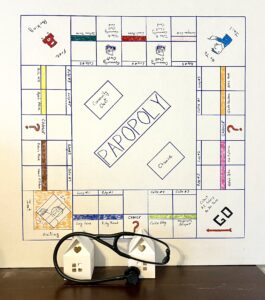
The Christmas of my diagnosis, the game I had made up was called Papopoly, a mish-mash of Papa and Monopoly. The kids rolled the dice and landed on properties with names like Ruby Ridge, Callie Corner, and Lucy Lane. Whenever they landed on each other’s properties, they paid fines out of the money I gave them to start the game. Otherwise, they landed on properties that rewarded them with their Christmas presents.
After Christmas, my diagnosis brought a new focus to how long and how well. Alone with my wife, I cried that the grandkids may never get another dumb Papa-game at Christmas, but once the tears flowed out, the memories of Papopoly and Family Bingo flooded in. My spine lit on fire with the sacred energy of Kundalini. How long is bitter; how well is sweet.
My first transfusion in January required that I cancel my slot at a writers’ conference in St. Petersburg that I loved. Bitter. When my wife’s first flowers bloomed that spring, the colors were she—my gift all over again. Even the fragrance of the new Keurig’s morning coffee seemed more pungent. Everything is more colorful and fragrant when you’re living well versus long.
I can read medical journals. The drug I’m taking is relatively new. Clinical trials resulted in a mean life expectancy of 2–5 years. I’m one year into how long, but a lifetime into how well.
My latest novel, which I abbreviate as HOMS, strongly resembles my family’s summers on Cape Cod (except for a ghost, a prisoner, and a drug deal gone bad). This Christmas, my grandkids each got a copy of the book stuffed with money and the requirement that they couldn’t remove any money until they read up to that page or had a Taco emergency.
I am now at the writers’ conference I love and gave copies of HOMS to several writer-angels who helped birth it. Each morning in our workshop, I’m working on my memoir, and nights I have resurrected the novel I started 10 years ago—a story about growing up in Boston’s North End during a bygone era. It’s my father’s story (except for a murder, a betrayal, and a stranger from Napoli).
A story written has the same measure as a life lived— not How Long, but How Well.
 Joseph K. DeRosa is a storyteller, and a writer of fiction and nonfiction. He is author of The House on Main Street: A Cape Cod Tale and Vera’s Story: Escape to Freedom. He has also been published in several short story anthologies in the 2013 and 2014 Chatham 02633 series (Lulu Press) and has essays available in Medium. Raised in Boston, Massachusetts, he currently lives in Cape Cod and South Florida. As a leader in information systems, he taught and gave talks around the world. Much of his writing is derived from his travels. Web Site: jkderosa.com, X: @derosabooks, Email: derosabooks@gmail.com.