
Fiction
Issue #18: Choices
April 20, 2026
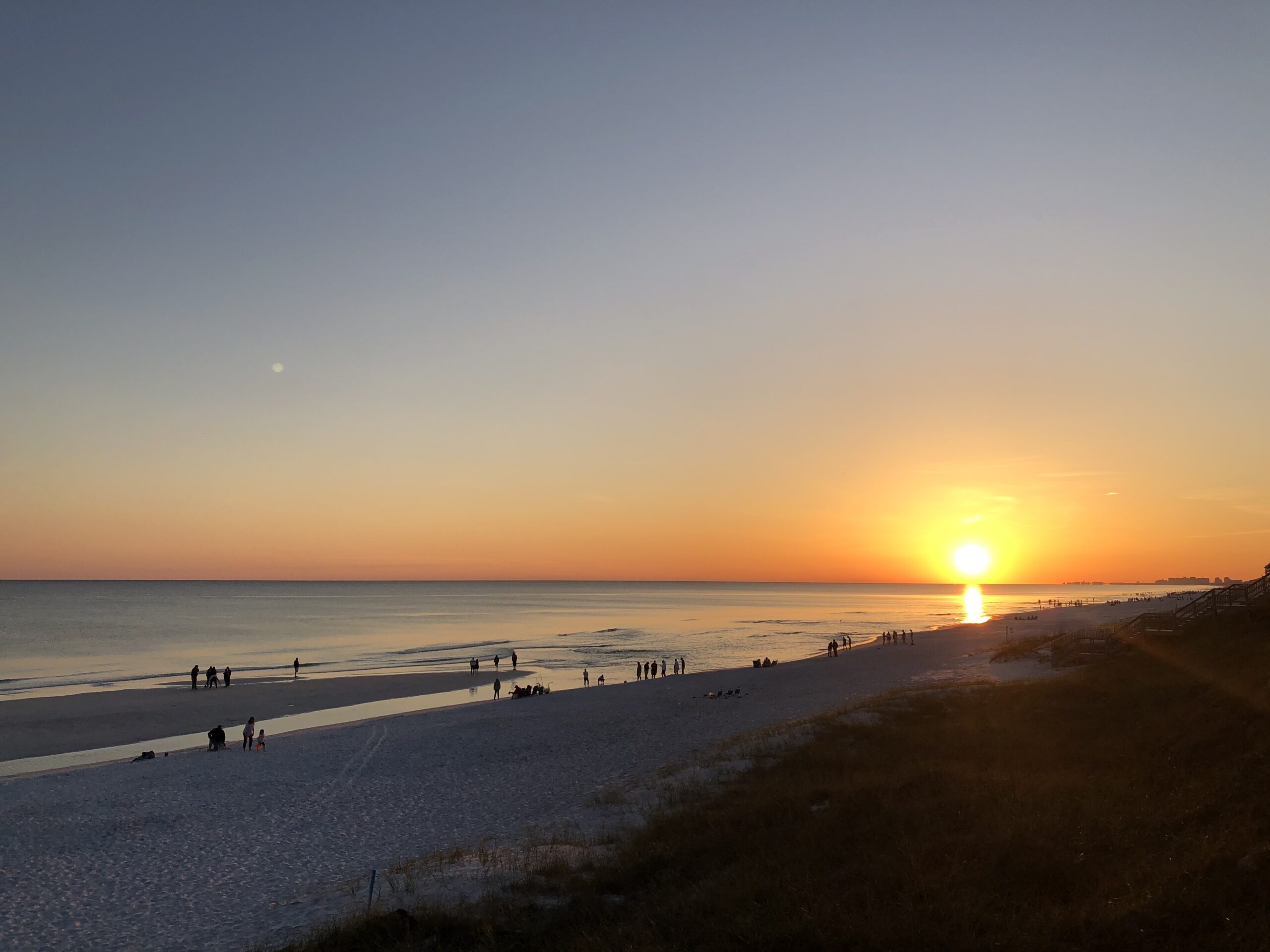
Low Tide
by Holmes Miller
By late afternoon, the beach is empty, save for Frank and Christina. Frank sits at the water’s edge with the surf lapping his suit. Beside him, Christina faces west so she can catch the last rays of the setting sun. Eyes closed and with a faint smile, her head is tilted back and the sun strikes her neck and chin, giving her tan face an orange glow. Frank studies her and thinks she looks young, much younger than she is. She could pass for thirty-five, save for the silver streaks in her hair and the faint crow’s feet by her eyes.
Turning toward the ocean, Frank kneads the wet sand as though massaging a dog’s back. The sea looks calm and whitecaps break lazily before reaching shore. The lifeguards have gone and the ocean is empty except for a lone swimmer beyond the buoys.
Frank has come to this beach every year since his oldest boy was a baby. Now his oldest is past thirty and his youngest is gone too, having graduated college this past June. Time flies. In the distance the lone swimmer fools around, waving his arms and bobbing up and down. He looks like a boy, showing off for someone else. But there is no one else, either in the ocean or on the beach, except for Frank and Christina.
The boy’s motions are unsettling and Frank wades into the surf to get a closer look. Something isn’t right. He stares, then walks over to Christina, whose eyes are closed, soaking up the last rays of the setting sun. “Wake up!” he says. “I want you to see something.”
She opens her eyes and stretches her arms. “What?” she asks, confused, still half asleep in her late afternoon beach reverie.
“Out there. Look,” Frank says, pointing toward the ocean.
She twists her body, then stands up, and shades her eyes. She stares for a few moments trying to discern anything. Finally she does. Out past the breakers, she sees the boy. She stares, trying to process the scene. She doesn’t answer, because to her, he looks like a boy having a good time.
“Do you think he’s in trouble?” Frank says.
Christina watches him and shrugs. “Why is he in trouble?” The boy’s arms move wildly, but so what? Maybe he is messing around. Showing off for himself. After all, he is a boy and boys do that. Her two boys did that. Even Frank, when they first met, did that.
Frank looks over the beach, hoping someone else has arrived, to get another opinion. Anyone. But the beach is empty except for the residue of wrappers, broken sandcastles, and seaweed washed up on shore. Seagulls hoot from above, swooping down and then back up into the sky.
“Should I go in after him?” Frank says.
Christina stares at him, somewhat surprised. “Is that necessary? He’s fine.”
Out over the water, the boy disappears for a moment, then reappears. “But what if he isn’t,” Frank says. “What then?”
Christina shakes her head and says nothing. Finally she says, “This isn’t an adventure movie. You don’t need to be heroic. Technically, you’re a senior citizen.”
“The ocean seems calm. I can get a closer look. That’s the least I can do, right?”
Christina shrugs. A lifetime with Frank has taught her that efforts to change his mind often won’t work. She is resigned and knows Frank must learn his own lessons, even when she has all the answers. “Go ahead then, feel free.” She pauses then continues, smiling faintly. “Okay, Aquaman, save humanity.” She squeezes his arm, then walks away, from the water’s edge toward a green wooden bench by the dunes.
Frank heads to the surf and walks in. The water is chilling. Earlier in the day, after swimming laps between the buoys at high tide, he was almost sweating when he got out. But now sees goosebumps on his arm and shivers. The sky has turned grey and that evening a storm might be headed ashore.
He wades in knee-deep. It is low tide and he has to walk further out before he can dive under to swim out. Then, he swims hard underwater, as long and as hard as he can, then surfaces to breathe. He looks back and has made little progress. Then, redoubling his efforts, he swims crawl. The ocean, looking so calm from the shore, is rougher out here and the undertow is strong and getting stronger. He strains with every stroke and his arms ache. He breathes hard and spits out some swallowed water. He stops, floats on his back, and looks back to shore, then ahead, at the boy, who is still far away. The ocean is too rough for him.
The boy is older than he appeared from shore, about fourteen. His slicked-back hair gives him an almost cocky look, like a Dead End Kid from an old movie. “Is everything okay?” Frank shouts.
The boy either doesn’t hear him, or does, but ignores him. He whips his head and suddenly starts stroking toward shore. Rather than flailing about, now his strokes are measured and powerful. Frank tries to stand and realizes he still can. The water line is up to his chin. He has made that little progress, although he rationalizes telling himself it is low tide. The boy is about twenty yards away and swimming confidently to shore.
Frank watches him swim, edging toward him, and when the boy passes by, Frank shadows, for a few strokes swimming behind, parallel, like a superfluous parent trailing an independent child. Then he stops and just watches the boy swim to shore, every stroke reminding Frank of how much he is not needed.
Reaching the shallows, the boy starts walking and Frank trails behind, his muscles trembling with fatigue. His chest aches and salt water burns his throat. Still in the water, Frank stops and stares ahead, watching as the boy emerges from the ocean.
Finally onshore, the boy straightens up, takes a couple steps, and looks back out to sea, smiling, probably thinking about what he just did, enjoying his performance.
For the first time he notices Frank, stares at him for a second, then looks away, with a who is this guy look. Then he bolts down the beach, suddenly, like a gull lifting from the sand and flying low along the shoreline.
The boy runs with the lightness of youth, free and natural. Frank watches him vanish beyond jetty, and feels hollow. Rather than a hero, he is just a witness.
In the distance Christina waits alone by the green bench. He walks toward her, smiling sheepishly, wondering how much she has noticed. The sand is cold and deep, each step heavy. He slouches and as he approaches Christina, he stands up straight, like the soldier he once was. Finally, she waves. The gesture is small, almost casual, as though acknowledging him from across a parking lot. She has seen everything and will say nothing. She stands up, her dress fluttering in the twilight breeze, and walks toward him, coming to take him home.

Holmes Miller is a recently retired professor of business at Muhlenberg College, a liberal arts college in Allentown, PA. He has a Ph.D. from Northwestern University and has published many refereed professional journal articles and book chapters. He also has published some fiction pieces over the years, most recently BUTTERFLY, a short story appearing in the March, 2025 issue of Killer Nashville Magazine, and “1960”, a creative nonfiction piece about baseball appearing in the Fall 2025 issue of Sport Literate.