

City of Gauze
by Tajwar Taher
It’s not that we’re heroes who go unheard.
We are heroes who are silenced.
We are heroes who are ignored.
We are heroes who are told
We have no right to exist.
last time I saw Dr. Ihsan he was walking out the front door of the hospital. White coat billowing behind him, he strode past the rubble that was once a neighborhood with determined steps towards an enormous tank. He stopped directly in front of its mighty gray gun barrel and turned his square chin up so he could stare right into the bore of the monster’s snout.
Someone took a picture from upstairs. The shot would go viral and become an iconic symbol of our resistance and resilience.
I cry every time I see it—for what was lost before, and all the suffering that followed once he was gone.
The soldiers in those tanks had been launching rockets around the hospital for months, steadily tightening the radius of destruction until a few struck the east wing.
“You have been given enough warnings! Abandon your posts! Flee to the south with all the others!” the soldiers barked through the microphone.
“This is a humanitarian plea. We will escort you to safety.”
Never mind that the crisis was their own making. Never mind that humanity did not extend to us. They considered us vermin, to be gassed out of our own homes and sent fleeing.
Or exterminated.
“Show us where you’re hiding the militants!” a soldier shouted on one of their many raids before the tank arrived, holding a rifle to Dr. Ihsan’s head, so he couldn’t raise his hands in surrender.
A second before, his hands were helping a young boy in the ER whose leg stump was littered with shrapnel. Dr. Ihsan set down his forceps with a sigh.
“Please give this boy a half tablet of acetaminophen,” Dr. Ihsan instructed me.
“That’s all?” I asked, glancing at the boy who was softly crying on the gurney.
“That is all we can spare. You know that.”
Dr. Ihsan stood up and addressed the soldiers. “We’ve already told you. The only ones here are patients and providers.”
The soldiers, unbothered in their gray fatigues, laughed an ugly laugh above the echoes of wailing and painful moans that filled the ER. Thick with bloodlust, they surveyed the room with hungry eyes like wolves on the prowl.
“You are all terrorists. It’s in your blood,” the unit commander said.
“Maybe if you run now, you’ll have a chance. But one by one, we will eliminate every last one of you evil demons.”
Dr. Ihsan frowned.
“If you’re so sure, why not destroy us already? Just drop a bomb on us and be done with it!” I shouted before Dr. Ihsan’s iron grip landed on my shoulder, holding me back from saying more.
One touch was all it took to cool me down—and probably save my life. The soldiers would have had no qualms gunning me down in the middle of the ER.
I could not fathom Dr. Ihsan’s unyielding patience. Despite the horrific injuries we encountered every day, the frustration of not being able to deliver appropriate medical care because our resources were being choked away from us at the borders of the warzone, knowing that our own homes were likely destroyed, and contact with our loved ones was inconsistent, Dr. Ihsan resolutely marched forward to greet each patient coming through our doors day after day. He never once stopped to complain or threatened to quit. Not even when he was told his son had been murdered in an airstrike.
We saw tears fall from his eyes. His entire body quivered in silence as if at any moment he might collapse into a heap of dust. Before anyone could say a word, he excused himself and stepped into his office.
It was not long, however, before there was a knock at his door. Another ambulance had arrived.
“We need you, doctor,” the nurse standing outside his door quietly apologized.
With his cheeks still wet with tears, he opened the office door, nodded at her, and marched toward the ambulance bay.
We serve to survive a system,
A system that bombs and burns out
babies, beheaded.
Billions of you see,
not just the work,
but what their work has done to us.
And still you say:
“We want both.”
The soldier with the hollow eyes sneered at Dr. Ihsan. “Hurry up, you son of a whore. We have a mission to complete. We have lives to save. Show us where you’re hiding the terrorists,” he said, stroking the cold barrel of his rifle like a babe.
Dr. Ihsan raised open palms towards the soldiers. “Please go investigate as you wish. You will see we have nothing to hide.” He casually turned his back on the soldiers, returning to care for the whimpering child on the gurney.
The soldiers grinned. Hooting like a pack of hounds, they quickly dispersed through the hospital knocking over tables, yanking out drawers and tossing out supplies on the ground with abandon. They cackled as they stomped past terrified patients.
Bang!
Everyone in the ER instantly ducked down. Dr. Ihsan threw his body over the young boy with the amputation. When he confirmed that no more shots were being fired, he rose.
I followed him to source of the sound in one of our exam rooms. There, we found a soldier standing next to an ultrasound machine. The screen was riddled with cracks, a single bullet hole sitting in its exact center, a thin trail of smoke rising from within like the flourish of a pen inking an elaborate signature.
“Why did you shoot it?” Dr. Ihsan asked, anger crackling through his voice at last. “That was our only sonogram!”
“You’re mistaken,” the soldier replied. “Your equipment was already damaged. Maybe some debris from the ceiling fell and struck it. I wouldn’t be surprised.” The soldier gestured at our hospital’s decayed walls, a hospital that had withstood countless carpet bombs and rocket strikes over the years with no funds to rebuild it.
“That’s a lie!” I pulled out my cellphone and snapped a picture of the grinning soldier standing next to the shattered ultrasound. “The world will see this!”
The soldier laughed. “They will, but they won’t believe you. Or they won’t care.” The cellphone quivered in my hand. He was right.
“Without this machine, many innocent people may die. Some of them haven’t even been born yet,” Dr. Ihsan informed the soldier.
The soldier tapped the barrel of his pistol into Dr. Ihsan’s chest in reply. “None of you are innocent. Not even your babies.” The soldier kicked the ultrasound machine to the ground. “One more weapon of mass destruction neutralized.”
We watched, helpless, as the soldiers finished ransacking the hospital. They found nothing, of course, but promised to return.
We are chronically exhausted
with the world’s moral superiority.
The world that sanctions slaughter says
we are the ones that must surrender
to the democratic and progressive processes
of cultural erasure and Genocide.
A few days after the soldiers left, a woman was rolled into the ER, face writhing in pain, bleeding out from between her legs. “P-p-please…” her husband stuttered as he held her limp hand, “Our b-b-baby…”
He burst into tears. “Her contractions started a few hours ago…it t-t-took us so long to drive the c-c-car around the r-r-rubble. Then the soldiers came. I drove too fa-fa-fast. I didn’t see the other car. I b-b-braked.” He gulped, looking down at his wife. “I think she hit the dash.”
Dr. Ihsan pulled the man into his arms for a fierce hug. “We will do everything we can. Come sit down over here while we work.” After he deposited the stricken husband on a nearby chair, Dr. Ihsan returned to bedside. Looking at me with a stony expression, he said simply, “Abruption.”
I closed my eyes. “We have no ultrasound to confirm that. Or her dates. Or viability.”
“We will have to perform a cesarean.”
“We have no anesthesia.”
Dr. Ihsan affixed me with his ever-steady gaze. “We have no choice.”
The world’s moral injury is terminal.
Your morality dies with every murder
that your eyes deny.
Her screams. I will never forget her screams.
We took an oath to do no harm, but there was no other way to save her baby. When I touched the scalpel to the bottom of her belly, I felt like a traitor. I saw all the tendons in her neck and arms tense as I drew the scalpel across. No sound escaped her lips as the horizontal red line blossomed upon her skin. She was strong. She had endured an entire pregnancy under fire and brimstone.
When we reached her rectus abdominus and started manually stretching her muscles apart, she began screaming. The sound pierced my heart, penetrated my mind, and shot down my spine. Dr. Ihsan put a gentle, gloved hand on top of my shaking one.
“You can do this,” he said softly. “I believe in you.”
The scalpel steadied in my hand. When I made the cut into the uterus, a flood of blood and amniotic fluid burst out onto the table. The scramble that ensued was a blur. We yanked the baby out—wasting no time to cut the cord—and handed him off to the nurses.
Towel after towel we pressed to the woman’s innards after the avulsed placenta was pulled off, praying and praying that the bleeding would stop. Dr. Ihsan threw down the stitches that would save her life, and we quickly closed her up.
The screaming stopped when she lost consciousness from the overwhelming pain.
The most devastating diagnosis ever made
was based on the apathy we heard
and the indifference we read
in the headlines.
Dr. Ihsan tapped his foot on mine. He found me hunched over, sitting on the ground of an empty room with my back against the wall. I was still gloved and gowned. The blood of the cesarean covered me from torso to toe, but I saw nothing through my tears. Dr. Ihsan said something that I couldn’t hear over the echoes of the woman’s screams in my mind.
I felt Dr. Ihsan turn and slowly slide down the wall to sit next to me. He pulled something out of the breast pocket of his white coat and handed it to me. It was a small piece of gauze.
I snorted. “We’ll need more to get all this blood off of me.”
“It’s not for the blood. It’s for your tears.”
I accepted the gauze.
Feeling the rough, interlaced fibers between my fingers, I dabbed the corners of my eyes and blew my nose.
“I’m sorry,” I said. “I don’t know what’s come over me. More than four hundred days under siege and now I decide to show weakness? Please forgive me Dr. Ihsan. I’m sorry you had to waste the gauze on me. I know our patients need it more.”
Dr. Ihsan smiled. “My boy, your tears are a symptom of having a soul. Of having humanity. There’s no organ more precious and more important to preserve than that.” He pulled out another small gauze pad from his pocket and wiped his eyes. He sighed. “Four hundred days, huh? Do you know how many days into this war I wanted to take my family and escape?” I shook my head. Dr. Ihsan sniffed. “Ten.”
“I don’t believe that.”
“It’s true. And every day, when we lose another ten or twenty patients in the trauma bay, I tell myself, ‘At least I’m here. At least I did my best.’ But it doesn’t make me feel any better.” Dr. Ihsan heaved a sob from his wracked body. “Now I must go tell that man that he is a widower and he lost a son today.”
We leaned into one another and sat on the ground in silence. The buzz of the ER still rumbled through the wall behind us. Every so often a rocket strike in the distance interrupted our peace, but for that moment I felt safe beside him.
Dr. Ihsan held out his piece of gauze. “Did you know the word ‘gauze’ is said to have originated from the name of our city? We were known around the world for being the greatest producer of such fine fabrics. Our land may be the epicenter of violence, but it is not the source. Our truth, our land, our people: we are the gauze that keeps the world’s soul from bleeding out.”
Dr. Ihsan stood up, patting his white coat free of dust. “Do you remember my first lesson to you? On how to stop bleeding?”
“Hold pressure?”
“Yes. And be patient,” Dr. Ihsan added. “The biggest mistake I see trainees make is not holding pressure for long enough. Be patient, even if it takes decades or centuries. We will be healed in the end.”
We who will never be known
by our names or
recognized in our professions
have never asked for the glamour
of our calling.
We were called to this sacred duty
by the cries of our people
and the hope for a home
that will be free.
When the soldiers rolled the tank towards the hospital, Dr. Ihsan said nothing. He did not wait for help to arrive. He did not wait for someone else to step up. He simply stepped out. He was the Medical Director of our hospital, and he knew that every life in that hospital was his responsibility. That day he walked the furthest he had been from the hospital since starting his shift four hundred and twenty-eight days before.
It has been five hundred and thirty-four days since the soldiers dragged Dr. Ihsan away from the tank and stuffed him into the back of a truck. No questions. No discussion.
There was a hearing two hundred days later. The judge concluded there was no evidence of Dr. Ihsan’s wrongdoing, but that he should remain in detention due to his “credible risk for violence and disruption of humanitarian military operations.”
The world remembers Dr. Ihsan with the picture of him standing in front of that tank, but I cannot see anything except for the emaciated figure he had become by the time of his hearing. Starved. Bloodied and bruised. It could not be the bright man who had been my mentor and friend.
My outrage at all the injustice done by the world has long since shriveled into a dull ache. Even when I heard about a parade in New York City that featured the soldiers who kidnapped Dr. Ihsan, lifted on floats, glorified as heroes, I was too busy with the patients on the table to care. I’m sure Dr. Ihsan would agree that we never have and never will ask to be put on a pedestal and be celebrated for our sacrifices.
We just want the bleeding to stop.
So, I hold the pressure.
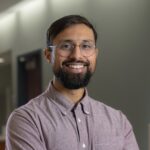 Tajwar Taher writes to resist. From a young age, he was taught that words have power – the revolutionary spirit of his native Bangladesh and inspiration from civil rights leaders through time compel him to use his voice to stand up against injustice wherever he sees it. As a Family Medicine physician in rural Oregon, he gets to interact with people who often don‘t look like him or may have different beliefs, but he find an affinity for all through shared humanity. It’s these perspectives he hopes to share through his writing, teaching medical students, and facilitating writing workshops in the community.