
Fiction
Issue #15: Free
November 1, 2025

Riptide
by J Bryan Michel
Sharp fragments of crystal glitter on the hot, black asphalt. One shard, roughly the shape of Florida, proclaims TOP DOCTOR; a smaller piece reads 2021.
Dr. Able Wilton freezes—legs shaking—wondering whether to scoop them up. He clutches a sagging cardboard box whose bottom has split open in silent mockery. It is 5 p.m. Colleagues in rumpled blue scrubs, a few wearing stethoscopes like necklaces, give him a wide berth as they cross the parking lot.
He feels shame—the same shame his father would have felt for him. On a dull, cloudy day a half‑century ago, Able last saw his father. The family had piled into the station wagon, its way‑back crammed with colorful beach towels and a cooler of Antone’s Po‑Boys. Together they waded into the cool, greenish water off Mustang Beach. Foamy swells rose and fell, interrupted every minute or two by a wave. Able delighted in being hurled into those onrushing breakers. At six he weighed next to nothing. Sometimes he flew too high, landing with a plunk behind a crest; other times he fell short, smacking the wall of water head‑first. All afternoon he feigned resistance, squealing and squirming as his father’s muscular arms nabbed him for one more toss.
As the sun set, he could just make out his mother at the water’s edge, waving in exasperation, desperate for them to come back in.
Then, without warning, his father was gone. Able waited, watched, listened, choking back animal screams. Tears blurred everything. His mother splashed in, and together they waded in circles, dipping their hands, searching in vain. Uncle Mort explained later how rip currents run silent and deep, waiting to pull under the weak and unwary. His father had stepped into one and was gone—forever.
That morning the blue‑clad security guard with a neck tattoo looked up from her phone and met his gaze—for the first time. She was young, maybe thirty, and round, though he knew better than to even think the F‑word (three letters not four). Her belly hung over a patent‑leather belt that supported a holster. No guns inside a medical center, he thought—probably a flashlight. She was almost certainly diabetic and at high risk for heart and kidney disease. Able told himself he wasn’t judging; people needed the truth.
As he passed, the guard stood and murmured into a walkie‑talkie then disappeared. Able wasn’t sure why he noticed any of this, but he did. Observation made him good at his job. When something was off—like the time Dr. Rozenbaum entered Grand Rounds with his fly open, yellow cartoon boxers on display—Able saw it. His hand gestures had saved the day.
Dr. Wilton joined Blessed Saints Clinic in 1999. Since then, “Blessed Saints,” BS to insiders, had merged and morphed more than a dozen times. Today it is part of a sprawling not‑for‑profit system of hospitals, physicians, and staff. Most simply call it the System.
He wakes daily at 6 a.m.—coffee, toast (no butter), shower. Before COVID‑19 he wore a tie; now he enjoys leaving the top button undone. At 7:25 a.m. he slides into a prime spot under one of the few shade trees in the physicians’ lot—impossible after 7:30 a.m. From there he joins the river of nurses, doctors, and staff snaking into the two‑story Father Alberigo Ambulatory Care Clinic.
When the clinic opened in 1982 its design won awards. Perhaps, Able mused, the architect had intended a low‑security cell block. Steel doors (reinforced?) opened with a pneumatic wheeze, triggered by footfalls on a rubber mat. A windowless hallway stretched for hundreds of feet, lit by fluorescent tubes caged behind chicken wire. Why chicken wire? he wondered. Fear of riots? Along the corridor hung black‑and‑white portraits of physicians, names and dates of service engraved below. Most were men, almost all were white; some start dates reached back to the 1800s. He doubted many still breathed. Gaps marked missing frames—removed or yet to be filled?
Able finished medical school in 1989. Uncle Mort, an internist, had urged him to apply. In high school and college Able earned extra cash doing odd jobs in Mort’s office. Medicine was simple back then: just doctors and patients, charts on paper, no integrated systems, no C‑suite of CEOs, CFOs, or COOs.
Mort taught that sickness and death surround us like an ocean. A physician is a lifeguard, keeping swimmers close to shore, away from the pull of the deep. The sea may lie calm for years, but storms aways arrive. Even strong swimmers can be dragged beyond rescue.
Every swimmer meets an end—by hurricane or by slow eroding tide. Physicians do what they can: pills, shots, and surgery. But eventually all are pulled under.
Last year a cerebral hemorrhage took Mort.
The clinic’s second floor, accessible only by elevator, is glass and steel, flooded with natural light and riddled with offices. Patient care happens on the first floor. Able enters with his practiced social smile. Dan is already at the nurses’ station, chair tilted back, legs twitching.
“Some second‑floor folks were here asking about you,” Dan says, easing the chair onto all fours. “That is not good.”
Able shrugs. “Probably forgot a learning module. Who knows.”
“Seriously. They cancelled your afternoon clinics and mentioned a meeting. Check your email.”
A red‑flagged message awaits. It’s from Beatrice D., Vice‑President of Experience and Compliance, complete with calendar invite:
1:00 p.m. – “Privileged and Confidential”
Circle Conference Room 600, 2nd floor
What had he done? A patient death? No—peer‑review would call first. An expense report? Last year’s Boston trip was by the book, though he’d ordered an extra Sunday breakfast fruit plate. Judy, his wife, had eaten it. She wasn’t an employee. Judy wasn’t even in healthcare. She was just a normal person.
Had compliance noticed?
At 1 p.m. Able sits in Room 600. A tall, frowning man types softly in a corner. Beatrice faces Able, expressionless, silk scarf knotted just so. She speaks in crisp, measured phrases—valued, member, support, contribution, grateful—that glide past without sticking. Then she focuses, mouth wilting into a smile.
“In your retention contract of 9‑1‑2020, did you agree to abide by System employment terms?”
“Yes,” Able says. Doesn’t he always comply? Isn’t that the game?
“You have read and understood the System’s Quality Guarantee Program?” She flips a packet toward him—his own initials beside section 35, paragraph 12, page 235.
He remembers Wizard. Two years ago, the CEO hailed a partnership with Truth Computing to run machine‑learning algorithms on a quantum network. Physicians balked—no one wanted care decisions from a faceless quantum doctor. Staff dubbed it Wizard; the name stuck.
“You’ve been flagged for practicing outside approved confidence limits,” Beatrice says evenly.
Wizard, based on quantum quirks like entanglement and tunneling, rewrites certainty: an egg sealed in a bottle can appear outside unbroken, Scientific American claimed. Binary yes/no yields to maybe. Gray replaces black and white.
“We ran your data a thousand times. The aggregate is conclusive.”
That’s the thing about quantum Able recalls, a single run can be wrong; the average is always right.
“What did I do?” he asks.
“We can’t peer inside the algorithm,” she says, “but it ensures the highest quality of care, free of human bias.”
Silence.
“Providers two standard deviations below the median are subject to termination.”
Wizard has crunched millions of Able’s variables: typing speed, word choice, the pitch of his voice, cafeteria purchases, thermostat settings. It knew of his secret work crush on Cheryl. It knows he skips broccoli and streams videos of dogs in silly costumes after work to unwind.
Able’s mind scampers like a squirrel on I‑95. Two decades of practice, thousands of patients—hadn’t he treated the Board Chair’s wife for dengue? She recovered. Did that matter? Had Wizard given him credit?
“You are a valued member of our family. The CEO will email the staff at day’s end, thanking you for your service. It will appear on Blabber, Shout, and Facebot. Your photo will be hung in the hallway, and you’ll receive this award.”
She places a crystal bowl before him: TOP DOCTOR – Dr. Able Wilton, 2021. “In exchange for three months’ salary, sign this NDA,” she adds, sliding a slim stack across the desk. “You agree not to disparage the organization, its officers, policies—”
Able isn’t listening. He will sign. Unexplained gaps in employment are red flags; word will travel fast—then fade. This tide will recede. He will not let it pull him under. Hold on, he thinks. The ocean will calm. Then he’ll wade back to shore and begin again.
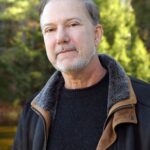 After 30 years in Medicine working as an academic, educator and clinician, J Bryan Michel spends his days writing and hiking in Asheville North Carolina. His debut novel The Devil We Know is expected in 2026. He is the author of numerous scientific articles and essays and was a semifinalist in the 2021 New England Journal of Medicine Fiction Contest.