
Fiction
Issue #17: Free
November 1, 2025
Talking When Death’s Been Close
by Graeme Richmond Mack
“We could keep trying this. But I think we need to stop,” says the doctor, a tall woman with a determined look. “He doesn’t like it when you push. Something’s not right.”
My wife, Isabella, and I look at each other. Her amber eyes shake. I feel a shiver inside.
“Ok, let’s go,” Isabella says suddenly, peering out at the pale, incandescent hallway.
“Can we get all hands-on deck? I need an anesthesiologist in the ER,” our doctor calls out as nurses scurry into the room, gathering devices, gesturing to one another.
In the ER, I sit with the top half of Isabella. The bottom half of her is engulfed by a clear dome, behind which lights flash and reveal the blue blur of gloves, the metal glimmer of tools.
I hold Isabella’s hand as the doctor works. I hear the play of time on the clock overhead. I watch fear ebb and flow in Isabella’s eyes, the tears in her eyes flush with light.
Suddenly, our son Nico is born. One nurse emerges from behind the dome and holds him out for us to see. Nico looks gray. Isabella meekly smiles. “Hi Nico,” she says in a frail voice.
The nurses carry Nico to a machine on the other side of the room. I watch them. For a few moments, neither Isabella nor Nico make a sound. I fidget with the edge of my sleeve. I hold my breath.
“He’s fine,” one nurse tells me after noticing my gaze. But she looks worried.
“He needs to go to the intensive care unit for observation,” the other nurse says. The nurse next to Isabella nods. “You should go, too,” Isabella half-whispers.
***
I sit with Nico in the ICU and watch nurses flow in and out, the hushes of the doors suctioning open and closed sound like the shivering of wind.
I look at Nico who lies naked under bright white lights, all suction cups and wires across his chest. I’m meant to watch his head for any additional swelling. Surely, somebody else was better suited for the job than the anxious father. But the job was mine.
“He’s got meconium in his lungs—black stuff—and he needs to get it out,” the nurse in the ICU tells me. “Get him to make sounds if you can. The more he cries at this point, the better.”
I’m not supposed to pick him up. “He’s still recovering. We need his head to heal,” the ICU nurse reminds me sternly. I rub my thumb on his wrist. “Hang in there, little buddy,” I say.
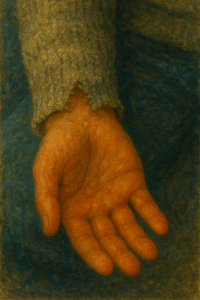
For the first time, I notice a tear in the sleeve of my sweater. As I hold Nico’s tiny fingers, I can’t stop looking at the tear. I wonder how I’m going to keep my shit together. How I’ll carry on without tearing the fabric.
I look at Nico. My eyes turn over and I feel hot tears on my cheeks.
I imagine Isabella, alone, surrounded by hospital music: machine beeps, muffled feet, clanging wheels. A hum and a din, every now and then, pierced by cries for help from the intercom.
I feel afraid of what ghost plans to visit us in the night. My stomach clumps up.
“Hang in there, buddy. Everything’s going to be alright.” I tell Nico. He looks up as if he wants to call out. I want to pull out the black stuff so he can, but I don’t know how.
Sitting up tall, I roll my sleeves up, making sure to not tear the fabric. I reach out and rub Nico’s arm and watch his fingers make a tiny fist. I run the back of my hand along his cheek.
***
Hours later, Isabella arrives at the ICU in a wheelchair with Stephanie—a nurse from the Postnatal Unit. “Can I feed my baby?” Isabella asks, her eyes wet, her forehead tight. The nurses shift at their station. “Of course,” says the head nurse.
Isabella carefully takes Nico into her arms and begins feeding him. As Isabella holds him, the nurses relax. One nurse whispers to the others about her college friends. “They go out every night and all I can ever tell them is no, I’m a grandma, just no.” The nurses quietly laugh. “Give ‘em hell, girl,” says another nurse. Nico’s skin radiates a warm pink.
Every now and then, I rest my head in my hands and close my eyes. Lightly dreaming, I keep waking to Isabella’s voice with a thump in my heart.
“I can’t tell you enough…how much your help means,” Isabella tells Stephanie, her voice breaking up with tears. I could hear the dip in her throat, the raw pinch of emotion.
“Thank you so much,” Isabella murmurs.
“Of course, honey. That’s what I’m here for,” says Stephanie. “Here. Take this. Get some sleep.” She passes Isabella a small, white cup, filled to the brim with a green fluid.
“Nico’s making a great recovery. We’ll wake you the next time he wants to feed.” She puts her hands on top of Isabella’s and smiles.
“Thank you. Really. You being here with me this whole time, talking me through it…it means…more than you know.” Isabella reaches for Stephanie who leans forward and they hug. I hear Stephanie sniff.
I remember how the light stole away the shadows that night as I told myself I would never take anything in life for granted again.
I would, of course.
But there was no unhearing that hospital music, either.
“Sometimes it’s just talking that we need, my dear,” Stephanie says in a calm and soothing voice as she adjusts Isabella’s pillow.
As I listen to them, I watch Nico catnap in a clear bassinet. Swaddled to the chin, Nico’s pink face is glowing.
Deep in the shadows, I see the silvery ghost yawn and slink off into the night.
 Graeme Richmond Mack is a college history professor who writes flash fiction and historical commentary that has appeared in literary magazines, journals, and on platforms, such as BigCityLit, the Northwestern Indiana Literary Journal, Bright Flash Literary Review, Please See Me, Literary Garage, Suddenly, And Without Warning, the Washington Post, The Conversation, H-Net, Yahoo!News, and the Journal of San Diego History. He is also a reader for Flash Fiction Magazine. Originally from Canada, Mack studied history and literature, earning his B.A. at the University of British Columbia in Vancouver, M.A. at McGill in Montreal, and Ph.D. at the University of California, San Diego. He lives in Virginia with his wife and young children.