
Memento Mori
by Carole Duff
I angled the heavy tome out of the bookcase and placed it on the end table next to my recliner. Quiet reading during my recovery from aging-female surgery. The novel, Helen Hooven Santmeyer’s “…And Ladies of the Club” had likely been one of Mother’s book club selections. But the notes scrawled inside the front cover were those of my father, who had died years ago.
Flipping through the pages and scanning the vertical lines he’d drawn in the margins throughout the book, I realized most of his notations related to John (Dock) Gordon. My father was also a doctor, a professor of pediatrics and medical sociology, who mostly saw patients in the teaching hospital associated with the university. Despite those institutional structures, he, like Dock, practiced in the mode of a bygone-day family doctor.
As a bookmark, he’d used a boarding pass: Northwest Orient, Smoking No, Economy Class 9C, Departure Gate 8, Flight Date 215, M 25Sep86, Destination MPLS/ST PAUL, Point of Issue LGA/215, Passenger Name: Duff/R.
He must have read the novel during his trip to meet with the grant foundation that funded his research about the quality of pediatric care. Likely his last flight, because a massive right-brain stroke felled him on November 2, 1986, his sixty-third birthday. My father died of heart failure ten years later. In the interim, he wrote about his life, personal papers I keep in the file drawer of my desk.
Memento Mori: Remember death, remember you will inevitably die.
Memento Mori: Book notations, a boarding pass, my father’s stories. And two more physical remembrances of my father that I keep: a Charles Schulz Peanuts comic strip and the Bible his mother gave him in 1943 before he went to war.
War is a dreadful thing
At the beginning of “…And Ladies of the Club,” which spans the years 1868 to 1932, the reader is introduced to Anne Alexander and her fiancé John “Dock” Gordon. Trained as a medical doctor by Anne’s father, Dock served as a field doctor in the Civil War, an experience that changed him.
A section, marked by my father, in which Dr. Alexander speaks to his daughter Anne: “John lets himself be haunted by the suffering he sees, and that won’t do in a doctor. Because it isn’t in a man not to dodge suffering if he can. And when a doctor begins to withdraw, like a snail into its shell, refusing to face the things he must face, then he isn’t going to be much good. A doctor, if he’s going to help his patients, must be there, like a rock, for them to lean on, not looking the other way; he’s got to be ruthless and callous.” (56)
My father was born four years after the end of World War I on a farm in far northern Maine. His family lived more like Dock’s in post-Civil War America with no electricity or plumbing except for a hand pump next to the kitchen sink. A wood-burning stove in the kitchen and a wood-burning furnace under the house provided heat. Indoor plumbing and electrical power would not be installed until after my father left home in 1943, when at age nineteen, he was ordered to duty.
About basic training at North Camp Hood, Texas, he wrote: “…I was in the middle of several wars: WWII, the Civil War (which our captain, a Southern man was still waging against Northern soldiers), and a class war. Trainees were all college students while our leaders were ‘poor white trash.’ They were crude, rude, even cruel sometimes… Many in training fainted in the heat; some died. I looked on in horror…”
I pondered my father’s use of the term “poor white trash,” how his parents with ten children were poor and white but too proud to accept assistance. My grandfather sold his potato crop futures to the railroad owner to pay my father’s college tuition. On a societal level, class, race, politics, and social movements such as women’s rights permeated Dock’s life and ours nearly a century later, but it was war that shaped both Dock and my father. Dock was trained to heal; my father, an engineering student, was trained to kill.
“I did not want to kill anyone,” he wrote, “but God help the threatening enemy who got into my sights for my aim was deadly, and I was steady… My father had taught me how to use dynamite, and the army taught me how to use artillery and TNT. War is a dreadful thing…” Perhaps an explanation for why my father embraced atheism.
After the war ended, he took advantage of the GI Bill and became what he’d always wanted to be, a doctor. That decision meant two extra hard-scrabble years of college followed by years of unpaid medical training, and moonlighting to support his wife and three children. In the 60s, my father spoke against U.S. involvement in Vietnam, but I don’t recall him watching the almost nightly TV news footage of the carnage and body count reports as I did. And yet, how far removed my life was from the realities of war, and how naïve I was as a college student, watching M*A*S*H—a satiric comedy. The doctors were often ruthless and callous, efficient and detached in the operation room, exuding omniscience and certainty, bullying the weak and less talented, unforgiving of mistakes. Playing God as they’d been trained.
A regular M. Deity
My father crafted a wooden frame for a Peanuts comic strip to hang above the door of the walk-in-back-out half bathroom he’d installed in the corner of my parents’ bedroom.
In it, as Charlie Brown and Linus walk along, Linus says, “When I get big, I’m going to be a very famous doctor.” Charlie Brown looks at Linus, who faces front, arms wide. “I’ll save everybody! I’ll perform miracles of surgery!” Looking at Charlie Brown, Linus points his right index finger toward the sky. “I’ll diagnose swiftly and accurately! I’ll work wonders…” Walking along again and still pointing to the heavens, Linus says, “I’ll be a regular M. Deity!!” Charlie Brown faces front, his facial expression bewildered and sad.
Whenever I look at that comic strip, which hangs on my office wall, I hear my father’s bitter, deep baritone, staccato laugh. “Ha! Ha! Ha! A regular M. Deity.”
Like Dock and Anne’s father, mine practiced medicine while training doctors. I remember him saying, probably when I was in high school, “I trust a [medical] Resident who says he’s in it for the money, because he’s more likely to make it. I always worry about those who want to save the world, because they have a hard time accepting failure.” This after one of his pediatric residents walked into the ocean and never came back.
I’ve taken it and dished it out
Doctors know patients have high expectations of their ministerial powers, placing physicians in positions of ultimate authority. When Anne asked her now husband Dock why he and her father couldn’t tell their patients the truth and let them decide, he responded: “And you a doctor’s daughter! You should realize that we must seem to know what we’re doing, even when we don’t. If we lose the faith of our patients, the battle’s lost… The first time they saw us look dubious they would call in someone else…” (96)
I noted Dock’s loaded words—seem to know, lose the faith of, battle’s lost, dubious—and referred to my father’s writing: “In my life, I have been subject to parents and then became one; subject to doctors and then became one; subject to officers in the army and then became one; and subject to professors and then became one. Now, as a patient, I am subject to doctors (some of them also professors) again. In a word, I have taken it and also dished it out, and I have seen others take it and dish it out to others.”
Both Dock and my father grew in compassion over the years. Dock was especially sensitive to the plight of his female patients in difficult marriages. Somewhat similarly, my father became a sharp critic of his profession and staunch advocate for children, especially newborns, and their families: “My profession often thinks of the sick as capricious and mentally retarded… The point I want to make here is that the knowledge and wisdom of the sick and their families are in the final analysis our best teachers, and they don’t even demand tuition.” He trusted families to make the tough decisions because they, much more than their doctors, lived with the consequences.
A hard thing to live with
Anne and Dock had two children: Johnny, who like his father became a doctor, and Belinda “Binny,” who died in her early teens from complications of rheumatic fever. Dock didn’t have the knowledge to save her—no one did.
Dock speaking to his son Johnny: “That is one thing you will have to face: the frustration, the helplessness, a doctor feels when he is presented with a hopeless case that he believes he could cure if only he knew more. But that is not the worst. The worst is when a case becomes hopeless because he guessed wrong in the first place.”
Johnny looked his astonishment. “But you have never lost a case because you were wrong!”
John smiled grimly. “I think you really believe that. I’m grateful. But yes: I have guessed wrong, or gambled on taking a chance with some new treatment… And I have lost patients I shouldn’t have lost. That’s a hard thing to live with. And you have to live with it, get used to it, not let it affect you, because if you do you’re no use to anyone. The next time you see Death come out of the corner of a room to stand by the bedside, you have to be bold enough to gamble again, if need be.” (623)
A hard thing to live with. As a child, I, like Johnny, believed my father, the engineer and doctor, could fix anybody and anything. But, since it was common practice then and now for doctors not to treat their family members, I didn’t experience my father in his role as a doctor. Until one day when I was in fourth grade.
I’m sitting with my mother in the emergency room, holding my left arm still. Hours before, while showing off on the monkey bars, I’d fallen and cracked my left elbow. My parents were accustomed to my misadventures, but this was the first time they’d landed me in the ER. Late in the afternoon, our family pediatrician Dr. Salinger walked in and saw us waiting. “This child is in pain,” he said in a loud voice. “This is inexcusable. Help her immediately.”
My father appeared from seemingly nowhere, his shoulders slumped. “I’m the director of emergency services, and I can’t even take care of my own child,” he said to my mother after Dr. Salinger left. Soon I was wheeled into x-ray then into an operating room to have my arm set.
Later, in adolescence, I interpreted my father’s words as self-centered pity, maybe because I needed to emphasize his inadequacies in order to leave home. Now, reading my father’s notations, my heart understood. Emergency Room triage is a gamble, based on limited knowledge and best guesses. A seemingly straightforward broken arm could wait, other cases likely not. Who would have been blamed for putting me first, for guessing wrong about the other cases? My father. And that would have been a much harder thing for all of us to live with.
Though child, adolescent, and young adult experiences live on in memory, my mature self can revisit that past and forgive us both. Forgiveness, gift from Memento Mori.
Pushed closer to suicide
Miss Pinney, an older unmarried woman who ran her own school, suffered from sciatica and had become addicted to laudanum, a medically prescribed opium mixture. From their children, the ladies of the club heard about their teacher—also a club member—falling asleep during school hours. The ladies stepped in, closed the school, and moved Miss Pinney to a modest house, making sure she had enough to live on—but not enough for laudanum. For her own good, or so they thought. Days later, she died.
Anne in conversation with her husband: “What did she die of, then?”
“Heart failure. She had gone into a closet for something, and the door jammed shut behind her. I suppose she was frightened when she couldn’t get out, and if she couldn’t get her breath—she was old and sick; her heart failed. I don’t think any of us ought to wish that she had gone on living, when she suffered so much. Let’s leave it at that, and say no more about it.” (400)
But Anne pressed for the real truth, and Dock told her: “Miss Pinney had gone into that closet with a lighted candle, locked herself in, and tried to burn the house and do away with herself by setting fire to the clothes hanging there… The edges of the door were charred, but it wouldn’t open. We had to chop the lock free…”
“You mean she did it on purpose? Suicide?… But couldn’t it have been an accident?”
“The key was on the inside of the closet door.” (401)
Two months after the stroke stole almost everything my father had been as a doctor and a man, he was admitted to the psych ward under suicide watch. In his papers, he wrote, “I never made a suicide attempt… I just wanted a doctor… to hear my thoughts and understand.” Instead, “I was pushed closer to suicide…”
Reading his words, I wondered if he’d thought about Miss Pinney.
His doctor told him he’d made an excellent recovery from his stroke—the official truth. My father’s reply: “… you lie. You astonish me!… It serves only to make your service look good… and I think you know it. But, I think I should admit that I have sinned too. I have dictated hundreds of discharge summaries. Every time, I wanted to give a better look to things. I loved to say, ‘Discharged, cured,’ and I often lied to do that.”
The real truth. How many times have I told an official, self-serving story instead of the real truth? And lied, and still do. How do doctors—all of us for that matter—live with our lying selves?
Benediction
Passing of people, quick key, the last front cover note and reference with my father’s notations.
IN MEMORIAM
Miss Eliza Ballard
Mrs. Mary Ballard old age
Miss Susan Crenshaw ca [cardiac arrest]
Mrs. Louisa Deming
Mrs. Katherine Edwards kidney
Mrs. Gwen Evans
Miss Caroline Gardiner
Miss Lavinia Gardiner
Mrs. Anne Gordon
Mrs. Laura Maxwell
Mrs. Mary McCune TB
Miss Agatha Pinney suicide
Mrs. Sarah Rausch
Miss Amanda Reid
Mrs. Thomasina Travers (1140)
The passing of Dock: pneumonia. On his way to attend a sick child on a stormy night, he was thrown from his horse when it got off track. Hours later, linemen and snowplows found him dazed, his arm broken, and brought him home to Anne. He soon developed a fever and an incessant cough.
As days passed, his sunken cheeks and troubled brow reminded Anne of what he’d looked like after returning from war some thirty years before. At his bedside, he, Anne, and Johnny recalled the happy times, his laughing at the dinner table and love of chess. He’d had a good life. His last word: “Binny?” And Anne’s reply: “Binny’s all right…” Then his breathing stopped. He was sixty years old.
Unlike most of the characters’ deaths in “…And Ladies of the Club,” my father’s dying was prolonged, starting with a life-threatening illness in his early fifties followed by the stroke a decade later. Thereafter, his life was one of slow degradation, constant pain, incontinence and urinary infections, and decline punctuated by seizures, falls, a hip fracture and surgery. None of us wanted him to go on living with this suffering; none of us wanted him to die.
Toward the end, he admitted there had been good in those ten, post-stroke years. He read to and played checkers with his grandchildren and saw nearly all of them grow into their teens. He wrote his stories, read the Bible his mother gave him in 1943, and found faith again. Like Dock, he died at home. He was 72. Since I was far away, living in Texas at the time, I don’t know what my father’s last words might have been; those in his personal papers will have to suffice.
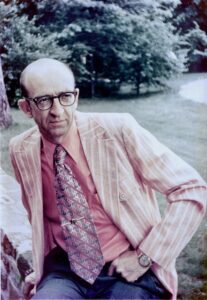
Of his three daughters, I am perhaps the most like my father, though you would never know by appearance. He likened himself to Ichabod Crane of Sleepy Hollow fame, tall and lanky, 6-foot-4 with large hands and gentle brown eyes. I’m a foot shorter with hazel eyes, a pleasant smile, and otherwise unremarkable. But my father was a truth-teller, as I am, a seeker of wisdom and mission-driven to the point of workaholism. Thank goodness, the toll of his work addiction served as a warning to me. Starting in my forties, I tried to curb my compulsion and allow myself more sleep, to enjoy the simple abilities of driving, mowing the lawn, and getting down on my knees. Things my father dearly wanted to be able to do again.
I am two years older than my father was when he died, and coping with aging’s vagaries. Arthritis and sciatica, though not as debilitating as Miss Pinney’s, and there are better treatments today. Although I shared my father’s atheism for many years, I became a believer mere months before he died. No coincidence. My first husband had left me with two young children to raise, my M. Deity was dying, and I needed all the help I could get. That desperate decision set me on the path of faith. Memento Mori shifted to Memento Dei. Remember God.
The last memento I received was my father’s Bible, which he’d left to my elder sister. Years later, while cleaning out her house, she sent it to me in recognition of my faith. I had the tattered Bible restored with explicit instructions to retain the simple frontispiece-dedication page: Holy Bible, Presented to Raymond S. Duff, July 14, 1943 by Mother, below which my grandmother wrote Num. 6:24-26. At the top of that page in Numbers, she wrote Benediction, and my father underlined the verses and drew three parentheses to the right of them.
The Lord bless you and keep you; the Lord make his face shine on you and be gracious to you; the Lord turn his face toward you and give you peace.
Memento Dei. God’s peace, Doctor Daddy. You did good.
 Carole Duff is a veteran teacher, flutist, naturalist, writer, speaker, and author of Wisdom Builds Her House and the companion guide, The Wisdom Journal. She posts weekly reflections to her long-standing blog Notes from Vanaprastha, hosted on her website, podcasts on her YouTube channel, and Friday Happy Hours stories and recipes hosted on Substack. She’s written for Brevity Blog, Cleaver Magazine, and Huffington Post, among others.